The Next
LUNAR
ECLIPSE
from
IoM
=============================================================================
The
next lunar eclipse visible from the Isle of Man occurs on the 28th
September 2015. As seen from the Isle of Man, the umbral shadow
enters the Moon's disc at 01.07h with the Moon at an altitude of 34°.
Totality begins at 02.11h with the Moon at 30° altitude. Mid
totality is at 02.47h with the Moon at 28° high. Totality ending
at 03.23h. The umbra shadow leaves the lunar disc at 04.27h.
Click
here for details.
=============================================================================
 The
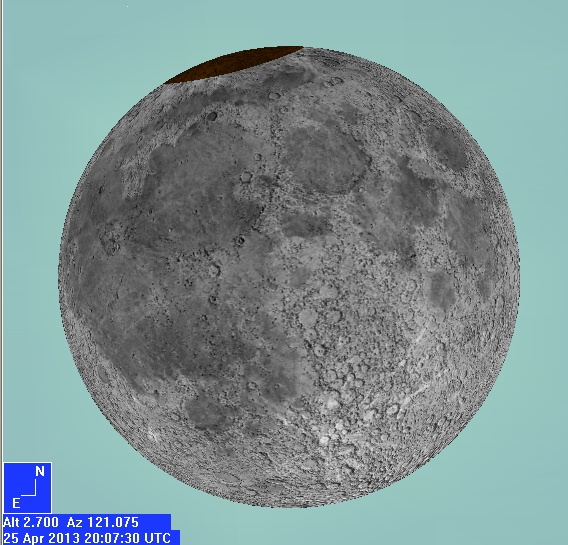
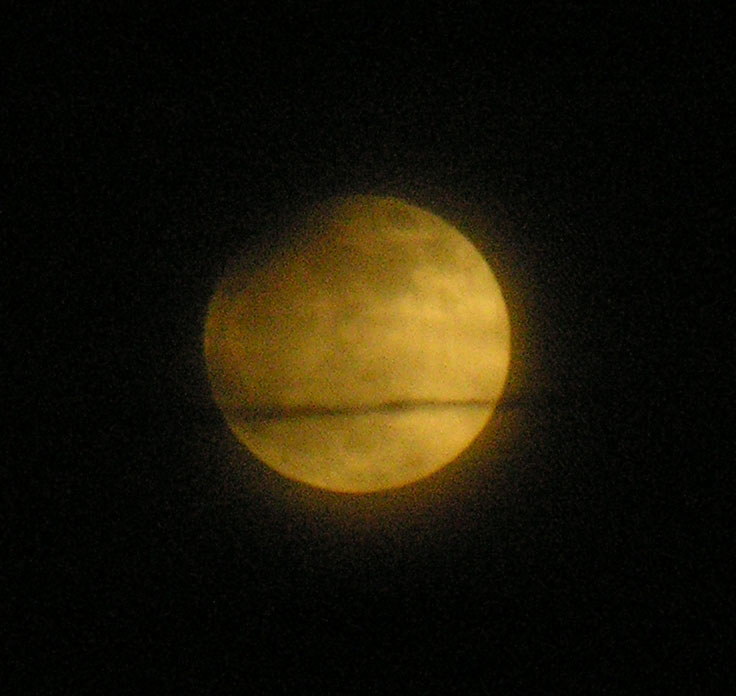
last lunar eclipse visible from the Isle of Man occurred on the 25th
April 2013. This was a partial eclipse. The maximum umbral
eclipse occurred at 20h07m30s
and covered only cover 1.5% of the lunar disc. As seen from the
Isle of Man, the Moon was low on the horizon but there was cloud on
the horizon making viewing difficult. Dave Storey obtained some
images just past the time of maximum.
The
last lunar eclipse visible from the Isle of Man occurred on the 25th
April 2013. This was a partial eclipse. The maximum umbral
eclipse occurred at 20h07m30s
and covered only cover 1.5% of the lunar disc. As seen from the
Isle of Man, the Moon was low on the horizon but there was cloud on
the horizon making viewing difficult. Dave Storey obtained some
images just past the time of maximum.
For details, click
here.
=================================================================================
 A
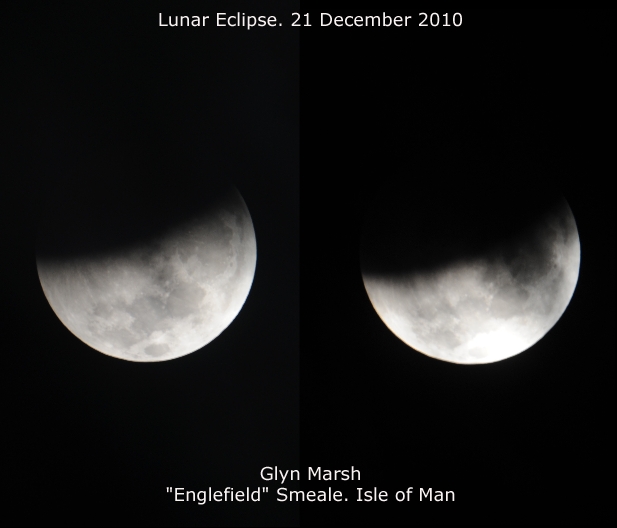
total lunar eclipse, visible from the Isle of Man occurred on 21st
December 2010. Unfortunately, the weather on the island was poor with
lots of cloud cover. Only two reports of some observation of the
eclipse were reported. Graham Gordon was able to see the very
beginning of the start of the eclipse but by the time totality had
arrived, he was totally clouded out. Similarly, Glyn Marsh was able
to get some views of the beginning of the eclipse through gaps in the
cloud. Through a finder telescope he was able to see some dark areas
of red colour developing. Alas, the cloud eventually covered the sky
and obscured everything!
A
total lunar eclipse, visible from the Isle of Man occurred on 21st
December 2010. Unfortunately, the weather on the island was poor with
lots of cloud cover. Only two reports of some observation of the
eclipse were reported. Graham Gordon was able to see the very
beginning of the start of the eclipse but by the time totality had
arrived, he was totally clouded out. Similarly, Glyn Marsh was able
to get some views of the beginning of the eclipse through gaps in the
cloud. Through a finder telescope he was able to see some dark areas
of red colour developing. Alas, the cloud eventually covered the sky
and obscured everything!
The
umbral phase of the eclipse started at 06.32:37 when the moon was be
15° above the horizon and setting. Totality started at 07.40:47
when the moon had dropped down to 6.4° above the horizon. The sky
would have become bright as dawn arrived and the moon set at 08.48h
still in the total phase.
Click
here for details.
================================================================================
On the
last day of 2009, the moon went into a small partial eclipse. At
maximum, it was covered by only 8%
of the Earth's shadow.
December had two Full Moons, so this eclipse also occurred upon the
face of a
Blue Moon!
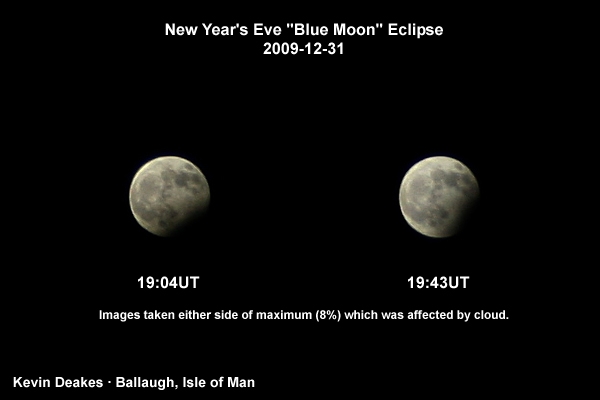
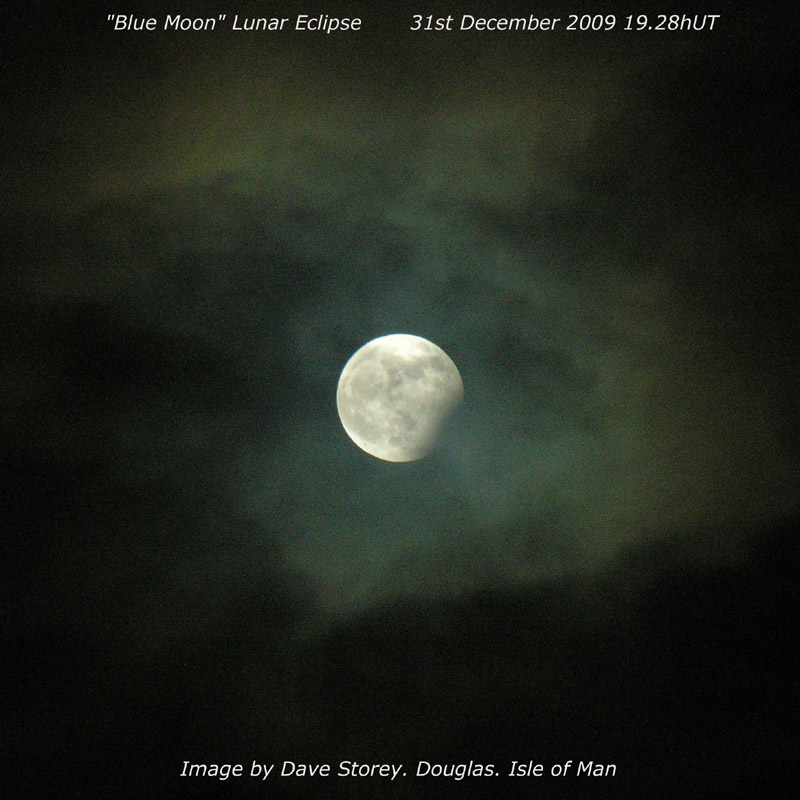
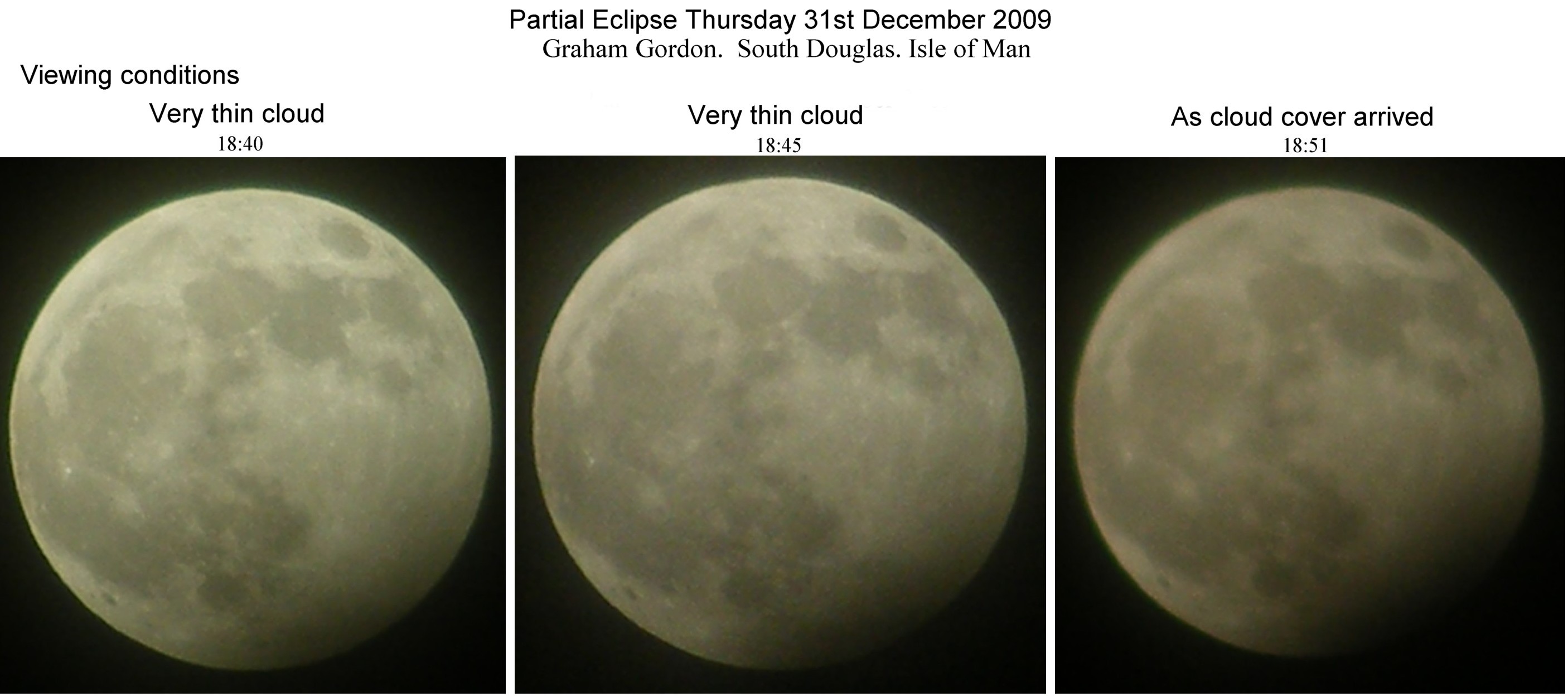
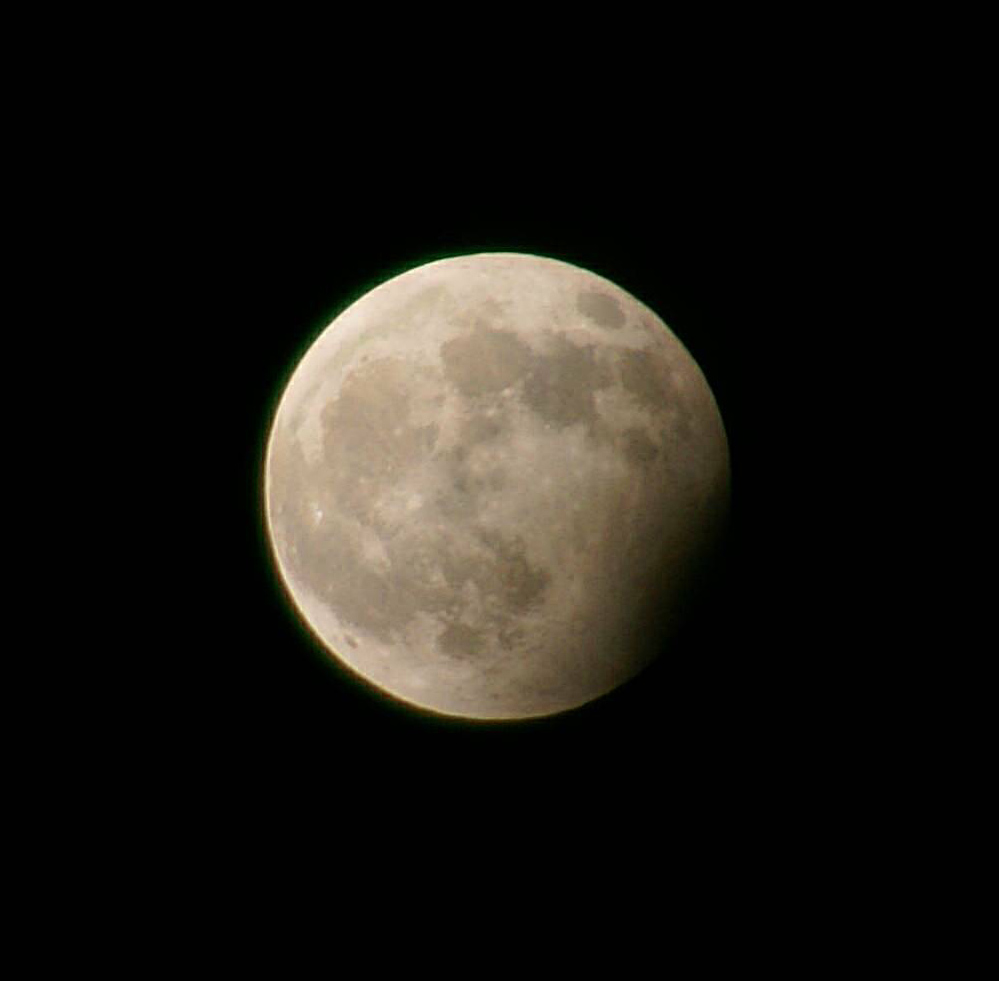
Image by Malcolm
Lambert. Port Erin. Isle of Man. 18.57h UT
The first and only
lunar eclipse visible from the Island in 2007 occurred on 3rd
March.
Below, imaged by Dave Storey, is a montage of the event.

The last lunar eclipse of 2006
visible from the Isle of Man took place on the evening of Thursday,
7th September, (as seen in this
animation
of the event,
600KB). No one really expected much from this event, as the eclipse
was only a small % partial eclipse; occurring at moonrise from the
IoM. As chance would have it, this date coincided with our "first
Thursday in the month" meeting, the first time since the
observatory was constructed that an eclipse has occurred on a club
night. A glance outside when this event was mentioned by our Chairman
during his address, resulted in a complete stoppage of the meeting,
for the view was truly spectacular for a partial eclipse.
A
number of members had binoculars with them that night, so quite some
while was spent outside observing the phenomenon. Unknown to the
majority, Dave Storey was his usual prepared self, taking photos with
his digital camera. When we all trooped back into the meeting room,
Dave had already prepared the images from his camera ready for us to
view on the data projector! What an astronomer!
And
below is the primary picture that Dave took on the night, for your
edification.

The Microsoft Spreadsheet links below detail all lunar eclipses
for the past 50 and future 50 or so years. They require Office 97 or
later, but if you do not have that software, you can download a free
Excel
Viewer (for Windows PCs) from Microsoft. The four
files have been modified to default to the latitude and longitude of
the Isle of Man Observatory. All eclipse calculations are by Fred
Espenak, and he assumes full responsibility for their accuracy.
Credit is detailed accordingly within the spreadsheets, Some of the
information presented in these tables is based on data originally
published in Fifty
Year Canon of Lunar Eclipses: 1986 - 2035.